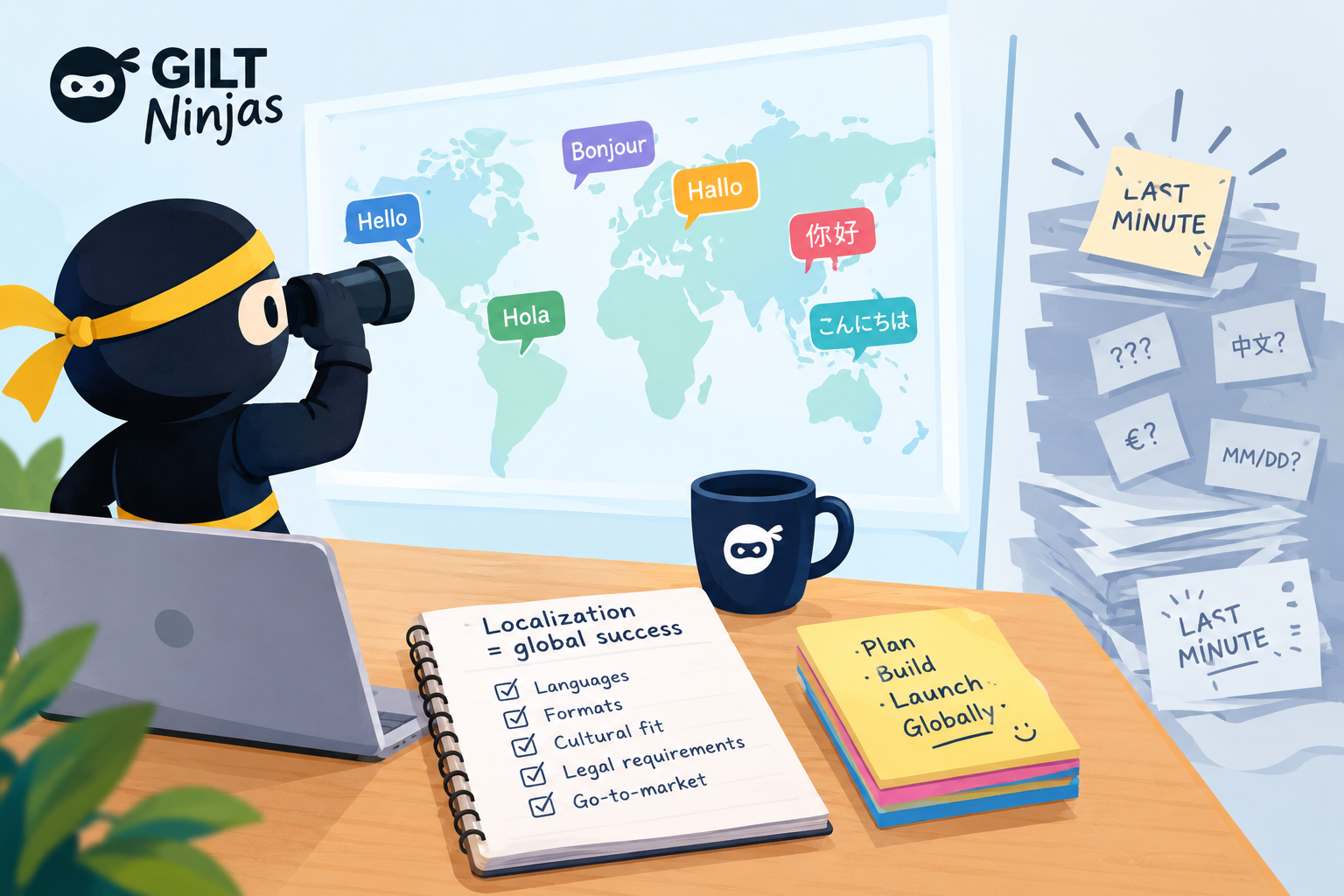
Sunny greetings, dear reader!
This is a mini-series for all the managers out there. It can also be helpful for globalization experience teams to recommend to their managers so everyone is working with a common baseline.
And don’t worry – you don’t need to become a localization expert. The goal is simply to know what to look for, what questions to ask and when to bring the right people into the conversation.
Let’s start with a familiar scene. A product team is deep in launch mode and everything is on track. Engineering is shipping, the design team has signed off, marketing is preparing the campaigns and leadership is aligned. The release date is already established.
Then, in a meeting that was supposed to be routine, someone asks a simple question:
“Has localization been involved yet?”
And that’s usually the moment everyone realizes: Localization was not thought of.
So what is localization, really?
Before we go further, let’s clear up a common misunderstanding. Localization is often treated as “translation”. Translation is part of it, yes – but localization is much bigger.
Localization is the process of adapting a product so it feels natural to users in a specific market or locale.
That includes:
- Language (of course)
- Dates, times and calendars
- Numbers and currencies
- Name and address formats
- UI behavior and text expansion
- Cultural expectations in design and content
- Search, sorting and data formats
- Legal and regional requirements
But there are actually two key pieces behind a global product: localization and internationalization.
Localization adapts a product for a specific market or locale. Internationalization prepares the product so those adaptations are possible in the first place.
Here are two simple examples.
Imagine your product is available in the US and Germany. A user in Germany with their language set to German should see the German version of the product. A user in the US might see English and US-specific formats and content.
That sounds obvious, but the product needs to know which language and locale to use and be built so it can actually serve the appropriate content and formats based on those settings.
Now consider something that isn’t a translation at all.
Imagine your product displays a date as:
03/04/2026
For a user in the US, that could mean March 4. For a user in Germany, it would normally be read as April 3.
Internationalization makes sure the product can handle different date formats instead of assuming that everyone uses the same one. Localization then makes sure the user sees the date in the format that makes sense for their locale.
Same product. Different language. Different formats. Different experiences.
And that is the basic relationship between the two: internationalization builds flexibility, while localization uses that flexibility to create a local experience.
Why PMs are involved (even if they never translate a word)
If you are a project manager, program manager or product manager reading this, you might be thinking:
“I don’t manage translation. Why is this my problem?”
Fair question. The good news is: you don’t need to manage translation.
Even if the product is not going global just yet, it can still be useful to consider how easily the product could adapt to additional markets:
- Requirements
- Design
- Engineering
- Testing
- Release planning
- Go-to-market execution
If localization is introduced too late, it can become a time-intensive and costly process.
The biggest misconception: “We’ll localize it later”
This is one of the most expensive phrases in product development: “We’ll localize it later and first decide everything based on only one market.” But here is the thing – “later” is where the cost shows up:
- UI refactoring for text expansion
- Rebuilding hardcoded strings
- Redesigning layouts
- Reworking formats
- Delayed launches in new markets
- Re-translating content that changed late
Localization is not difficult because it is complex. It is difficult because it is often retrofitted.
That doesn’t mean every product needs to be ready for every market from day one. But even if an international rollout isn’t on the immediate roadmap, it can be useful to consider how easily the product could adapt if that changes later.
And there is another reason not to assume that “we’re only targeting English-speaking markets” means “we only need to think about English”.
Take the US. English may be the primary language of your product, but the US is linguistically diverse, with a significant number of people speaking a language other than English at home. Spanish is by far the most common, followed by languages including Chinese and Tagalog. Vietnamese and Arabic are also widely spoken.
So even if your product is designed for the US market, “English-speaking market” does not necessarily mean “English-only users”.
The same applies elsewhere. In Canada, for example, both English and French are widely used. French has particular importance in Québec, where language requirements can affect products, services, content and customer communications. Depending on the market and product, these requirements can have legal implications, so it’s important to check the applicable regulations early.
In other words, “We’re not going global” can sometimes be a much more complicated statement than it sounds.
You may already be serving a multilingual audience without thinking of yourself as a global product.
When should localization enter the conversation?
Short answer: the sooner the better. Let’s continue the same launch scenario from earlier – but this time, we prevent the surprise.
Here are some points where localization can enter the conversation.
1. Vision and concept phase
Questions worth considering at the very beginning of a product idea:
- Is this product meant for one market or many?
- Are we assuming cultural norms from a single region?
- Could this feature work differently elsewhere?
2. Planning phase
This is a good point to bring localization into the planning discussion. Some useful questions are:
- Which markets are we targeting at launch?
- Which languages are required?
- What is the timeline for localization work?
- What content types do we need (UI, marketing, support, legal)?
- Do we have external vendors or dependencies?
- How does localization affect the roadmap?
If you are lucky, you have a globalization experience team that can help you with the questions above.
3. Design and development phase
This is where localization issues are often unintentionally created.
Common examples:
- Hardcoded UI strings
- Fixed-width layouts that break with translation
- Assumptions about date/time formats
- Single-language search logic
- Form fields that support only one naming and address structure
This is also where collaboration with localization experts matters most – not to translate, but to consult and prevent rework and blockers down the road.
4. Testing and QA phase
Localization testing is not just language review. It includes:
- UI overflow issues
- Broken layouts in translated strings
- Incorrect formats (dates, numbers, currencies)
- Cultural mismatches in content or imagery
Bringing localization QA in early can help catch issues before they reach production.
5. The “string freeze” phase
It eventually comes for any product – the string freeze, which means no more product text changes after a certain point.
If you make late changes or quick fixes at the last moment, it can cause the following for localization:
- Rework
- Delays
- Cost increases
- Version confusion
Think of it like repainting the inside of a house while people are already moving in. Possible, but not ideal.
6. Go-to-market phase
Localization includes everything around it:
- Marketing campaigns
- Landing pages
- Documentation
- Help center articles
- Training materials
- Support content
A fully localized product paired with untranslated launch materials feels unfinished for your users and can cause confusion, incomplete registrations, high support volume and potential customers who will pick another product that speaks their language.
The globalization orchestra
Global products are a team effort. Different teams bring different expertise to the table:
- Designers
- Engineers
- Writers
- Marketers
- Localization specialists
- QA teams
- Regional stakeholders
No single instrument makes an orchestra. And you might not need every instrument from the beginning. But if you know that more musicians may join later, it helps to leave room for them. Otherwise, you may need to pause the music and rearrange the orchestra to make space in the middle of the concert.
The same idea applies to global products. Thinking about localization and regional requirements early can make it easier to bring in additional languages, markets and expertise later, without necessarily having to stop and rework what is already in place.
Now we know “why” localization matters and “when” it should enter the conversation. But the next question is where many teams get stuck: How can localization risks be spotted before they become a problem?
Or put differently:
What are some of the questions worth asking so you don’t end up in that meeting where everyone is suddenly discovering localization for the first time?
Let’s find out in part 2: the localization questions worth asking. See you then!
Leave a Reply