Category: Going global
-
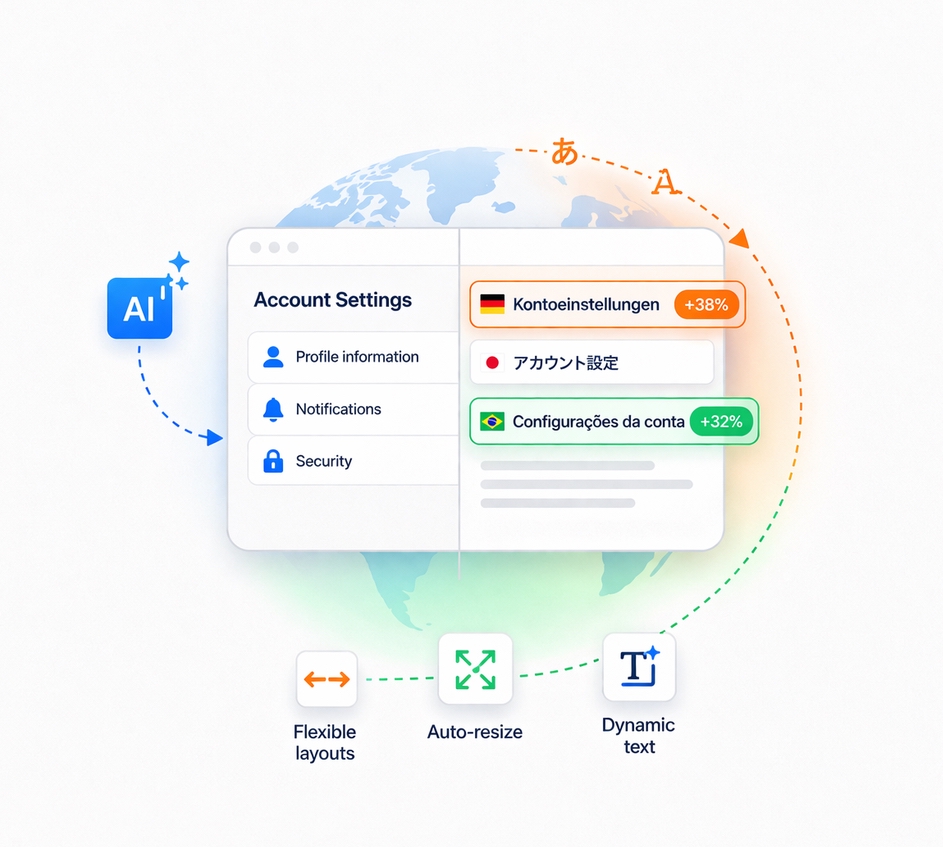
How to create designs that adapt to your global markets
One of the key areas for succeeding globally with your product is having a design that adapts to all the languages you support (and feels like it was built for them). If you don’t do this, you risk your global customers perceiving your product as foreign.
-

Global design – when layouts flip and fonts fight back
Sunny greetings, dear reader! Designing for the world means planning for every script and layout. Switch to Arabic, Hebrew, Chinese or Vietnamese and layouts mirror, arrows misbehave, fonts break and accents get clipped. Let’s dive into the hidden challenges of global UI.
-
Global design – where sleek UIs meet linguistic reality
Sunny greetings, dear reader! Think your UI is ready for the world? Think again. The cleanest layout can fall apart under the weight of longer words. Localization is where your sleek design meets reality and sometimes it gasps, flips or completely misreads the room.
-

How to start your product’s global journey
With the rise of large language models (LLMs) and their so well known translation capabilities, one big question keeps popping up: Do you still need a computer assisted translation (CAT) tool to take your product global?
-

Marketing vs organic growth: finding the right balance for international expansion
When companies expand internationally, they often face a classic question: do we go in strong with marketing or do we take a step back and let organic demand show us the way?
-

Payment localization – yes, it’s a thing!
When we talk about localization most people think of words, buttons and maybe a date format or two. But when it comes to global products nothing gets more personal – or more complicated – than money.
-

Marketing and the factors to measure international success
We talked about transcreation, globalization and international markets, and now we arrive at the grand finale: measuring success.
-
Marketing and achieving the best results for international markets
Not every marketing team has the luxury of having a dedicated counterpart in each target country to ensure campaigns are culturally aligned and locally relevant. In such cases, companies often turn to alternative solutions to bridge the gap.
-

How to generate a first-class resource file: usage of variables in strings
I’ve been revisiting our How to generate a first-class resource file series, and realized we missed one key piece, one of the most common and problematic scenarios when delivering localized content: broken strings caused by poorly handled variables.
-
Marketing and the extra steps to take to embrace other markets
If you are following our miniseries “Marketing and …” you should know by now that expanding into new markets isn’t just about translating content. It’s about making your brand feel right at home.